
Potential#
- class deepinv.optim.Potential(fn=None)[source]#
Bases:
ModuleBase class for a potential \(h : \xset \to \mathbb{R}\) to be used in an optimization problem.
Comes with methods to compute the potential gradient, its proximity operator, its convex conjugate (and associated gradient and prox).
- Parameters:
fn (Callable) – Potential function \(h(x)\) to be used in the optimization problem.
- bregman_prox(x, bregman_potential, *args, gamma=1.0, stepsize_inter=1.0, max_iter_inter=50, tol_inter=1e-3, **kwargs)[source]#
Calculates the (right) Bregman proximity operator of h` at \(x\), with Bregman potential
bregman_potential.\[\operatorname{prox}^h_{\gamma \regname}(x) = \underset{u}{\text{argmin}} \frac{\gamma}{2}h(u) + D_\phi(u,x)\]where \(D_\phi(x,y)\) stands for the Bregman divergence with potential \(\phi\).
By default, the proximity operator is computed using internal gradient descent.
- Parameters:
x (torch.Tensor) – Variable \(x\) at which the proximity operator is computed.
bregman_potential (deepinv.optim.bregman.Bregman) – Bregman potential to be used in the Bregman proximity operator.
gamma (float) – stepsize of the proximity operator.
stepsize_inter (float) – stepsize used for internal gradient descent
max_iter_inter (int) – maximal number of iterations for internal gradient descent.
tol_inter (float) – internal gradient descent has converged when the L2 distance between two consecutive iterates is smaller than tol_inter.
- Returns:
(torch.Tensor) proximity operator \(\operatorname{prox}^h_{\gamma \regname}(x)\), computed in \(x\).
- conjugate(x, stepsize_inner=1, max_iter_inner=100, tol_inner=1e-5, *args, **kwargs)[source]#
Computes the convex conjugate potential \(h^*(y) = \sup_{x} \langle x, y \rangle - h(x)\). By default, the conjugate is computed using internal gradient descent.
- Parameters:
x (torch.Tensor) – Variable \(x\) at which the conjugate is computed.
stepsize_inner (float) – stepsize used for the internal gradient descent used to compute the conjugate. Default is 1.
max_iter_inner (int) – maximal number of iterations for the internal gradient descent used to compute the conjugate. Default is 100.
tol_inner (float) – internal gradient descent has converged when the L2 distance between two consecutive iterates is smaller than tol_inner. Default is 1e-5.
- Returns:
(torch.Tensor) conjugate potential \(h^*(y)\).
- Return type:
- fn(x, *args, **kwargs)[source]#
Computes the value of the potential \(h(x)\).
- Parameters:
x (torch.Tensor) – Variable \(x\) at which the potential is computed.
- Returns:
(torch.Tensor) prior \(h(x)\).
- Return type:
- forward(x, *args, **kwargs)[source]#
Computes the value of the potential \(h(x)\).
- Parameters:
x (torch.Tensor) – Variable \(x\) at which the potential is computed.
- Returns:
(torch.Tensor) prior \(h(x)\).
- Return type:
- grad(x, *args, **kwargs)[source]#
Calculates the gradient of the potential term \(h\) at \(x\). By default, the gradient is computed using automatic differentiation.
- Parameters:
x (torch.Tensor) – Variable \(x\) at which the gradient is computed.
- Returns:
(torch.Tensor) gradient \(\nabla_x h\), computed in \(x\).
- Return type:
- grad_conj(x, stepsize_inner=1, max_iter_inner=100, tol_inner=1e-5, *args, **kwargs)[source]#
Calculates the gradient of the convex conjugate potential \(h^*\) at \(x\). If the potential is convex and differentiable, the gradient of the conjugate is the inverse of the gradient of the potential. By default, it is computed as the minimizer \(z\) of \(h(z) - \langle x, z \rangle\), i.e. the solution of \(\nabla h(z) = x\), using internal gradient descent.
- Parameters:
x (torch.Tensor) – Variable \(x\) at which the gradient is computed.
stepsize_inner (float) – stepsize used for the internal gradient descent used to compute the gradient of the conjugate. Default is 1.
max_iter_inner (int) – maximal number of iterations for the internal gradient descent used to compute the gradient of the conjugate. Default is 100.
tol_inner (float) – internal gradient descent has converged when the L2 distance between two consecutive iterates is smaller than tol_inner. Default is 1e-5.
- Returns:
(torch.Tensor) gradient \(\nabla_x h^*\), computed in \(x\).
- Return type:
- prox(x, *args, gamma=1.0, stepsize_inter=1.0, max_iter_inter=50, tol_inter=1e-3, **kwargs)[source]#
Calculates the proximity operator of \(h\) at \(x\). By default, the proximity operator is computed using internal gradient descent.
- Parameters:
x (torch.Tensor) – Variable \(x\) at which the proximity operator is computed.
gamma (float) – stepsize of the proximity operator.
stepsize_inter (float) – stepsize used for internal gradient descent
max_iter_inter (int) – maximal number of iterations for internal gradient descent.
tol_inter (float) – internal gradient descent has converged when the L2 distance between two consecutive iterates is smaller than tol_inter.
- Returns:
(torch.Tensor) proximity operator \(\operatorname{prox}_{\gamma h}(x)\), computed in \(x\).
- prox_conjugate(x, *args, gamma=1.0, lamb=1.0, **kwargs)[source]#
Calculates the proximity operator of the convex conjugate \((\lambda h)^*\) at \(x\), using the Moreau formula.
::Warning:: Only valid for convex potential.
- Parameters:
x (torch.Tensor) – Variable \(x\) at which the proximity operator is computed.
gamma (float) – stepsize of the proximity operator.
lamb (float) – math:
lambdaparameter in front of \(f\)
- Returns:
(torch.Tensor) proximity operator \(\operatorname{prox}_{\gamma \lambda h)^*}(x)\), computed in \(x\).
- Return type:
Examples using Potential:#
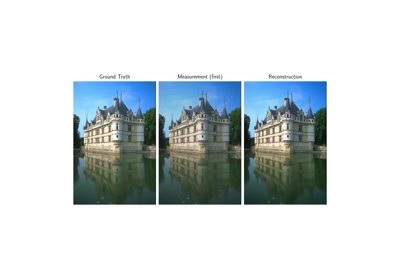
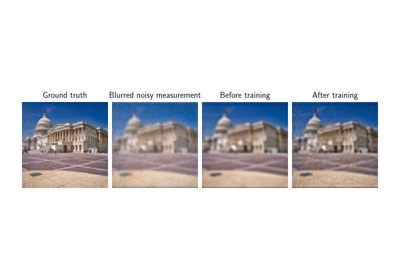
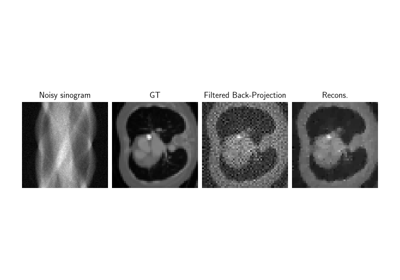
Low-dose CT with ASTRA backend and Total-Variation (TV) prior
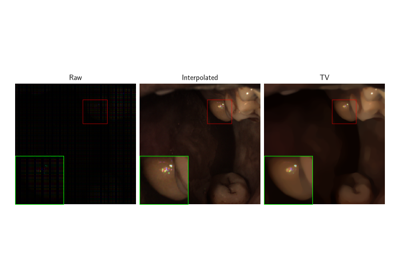
Reconstruct prospectively-undersampled raw multicoil MRI
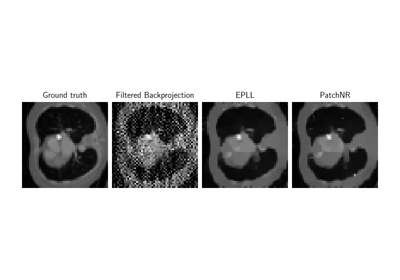
Patch priors for limited-angle computed tomography
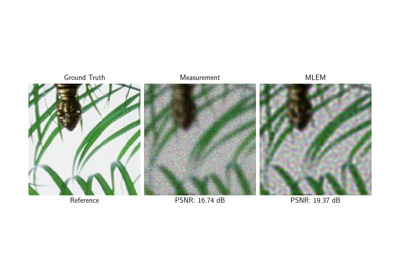
Poisson Inverse Problems with Maximum-Likelihood Expectation-Maximization (MLEM)
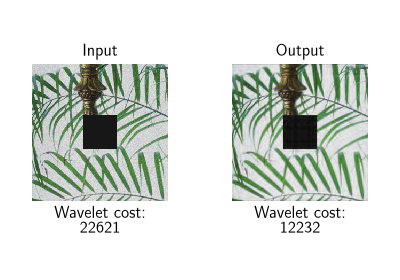
Random phase retrieval and reconstruction methods.
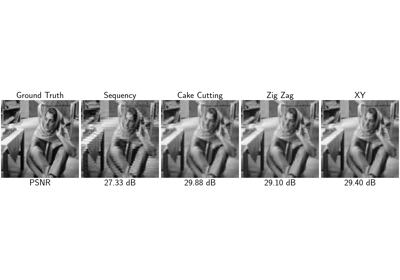
Pattern Ordering in a Compressive Single Pixel Camera
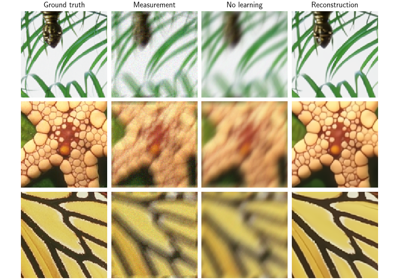
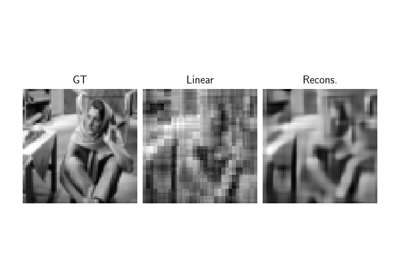
PnP with custom optimization algorithm (Primal-Dual Condat-Vu)
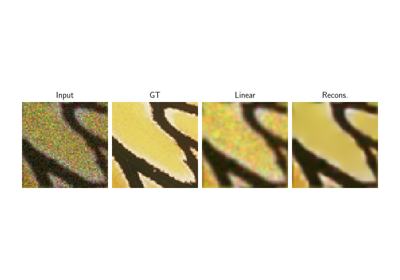
Plug-and-Play algorithm with Mirror Descent for Poisson noise inverse problems.
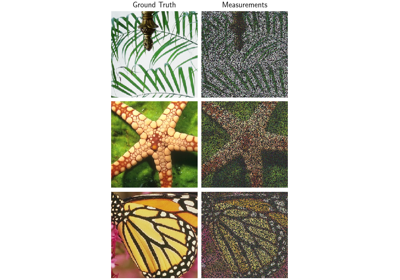
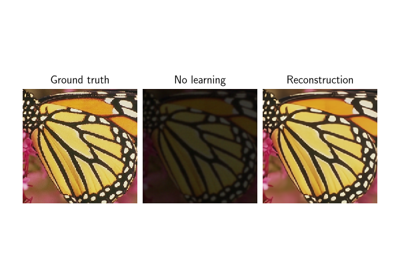
Regularization by Denoising (RED) for Super-Resolution.
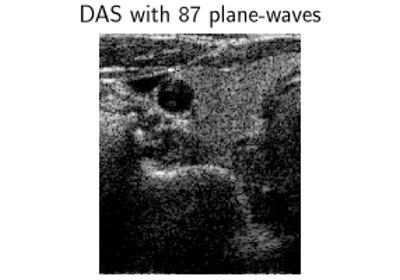
In-vivo ultrafast ultrasound reconstruction with Plug-and-Play
Using state-of-the-art diffusion models from HuggingFace Diffusers with DeepInverse
Building your diffusion posterior sampling method using SDEs
Flow-Matching for posterior sampling and unconditional generation
Noisy data-fidelity terms for diffusion posterior sampling
Deep Equilibrium (DEQ) algorithms for image deblurring
Learned Iterative Soft-Thresholding Algorithm (LISTA) for compressed sensing
Reducing the memory and computational complexity of unfolded network training
Unfolded Chambolle-Pock for constrained image inpainting