PiGDMDataFidelity#
- class deepinv.sampling.PiGDMDataFidelity(denoiser=None, weight=1.0, clip=None, cg_max_iter=3, cg_tol=1e-4, verbose=False)[source]#
Bases:
NoisyDataFidelityPseudoinverse-guided diffusion model (PiGDM) data-fidelity term.
This corresponds to the \(p(y|x_t)\) approximation proposed in [137]. For the VE parametrization \(x_t=x_0+\sigma_t\omega\), PiGDM uses the isotropic Gaussian approximation
\[p(x_0|x_t) \approx \mathcal{N} \left( x_0;D(x_t,\sigma_t),\Sigma_t(x_t) \right), \qquad \Sigma_t(x_t)=r_t^2\mathrm{Id}, \qquad r_t^2=\frac{\sigma_t^2}{1+\sigma_t^2}.\]For a linear forward operator and Gaussian measurement noise with standard deviation \(\sigma_y\), integrating this approximation gives a Gaussian approximation of \(p_t(y|x_t)\). Its negative log-likelihood gradient is
\[-\nabla_{x_t} \log p_t(y|x_t) \approx \lambda J_D(x_t, \sigma_t)^\top A^\top \left(r_t^2 A A^\top + \sigma_y^2\mathrm{Id}\right)^{-1} \left(A D(x_t, \sigma_t) - y\right).\]Here \(D\) is a denoiser and \(J_D\) is its Jacobian. The parameter \(\lambda\), exposed as
weight, controls the scale of the data-fidelity term. The inverse is evaluated exactly fordeepinv.physics.DecomposablePhysicsoperators and approximated with conjugate gradient for other linear operators. The measurement noise level \(\sigma_y\) is read fromphysics.noise_model.sigma.- Parameters:
denoiser (deepinv.models.Denoiser) – Denoiser network. It may be left as
Nonewhen the data fidelity is passed todeepinv.sampling.PosteriorDiffusion, which supplies its denoiser.weight (float) – Weighting factor \(\lambda\). Default:
1.0.clip (tuple[float]) – If not
None, clip the denoised output into[clip[0], clip[1]]interval. Default toNone.cg_max_iter (int) – Maximum number of conjugate-gradient iterations. Default:
3.cg_tol (float) – Relative conjugate-gradient tolerance. Default:
1e-4.verbose (bool) – If
True, print conjugate-gradient convergence information. Default:False.
- grad(x, y, physics, sigma, *args, get_model_outputs=False, **kwargs)[source]#
Compute the PiGDM data-fidelity gradient.
\[-\nabla_{x_t} \log p_t(y|x_t) \approx \lambda J_D(x_t, \sigma_t)^\top A^\top \left(r_t^2 A A^\top + \sigma_y^2\mathrm{Id}\right)^{-1} \left(A D(x_t, \sigma_t) - y\right).\]- Parameters:
x (torch.Tensor) – Current noisy iterate.
y (torch.Tensor) – Measurements.
physics (deepinv.physics.Physics) – Linear physics operator.
sigma (torch.Tensor, float) – Diffusion noise standard deviation.
get_model_outputs (bool) – If
True, also return the denoised output along with the score. Default toFalse.
- Returns:
PiGDM gradient, with the same shape and dtype as
x.- Return type:
- solve_inverse(physics, u, r_t2, sigma_y)[source]#
Apply \((r_t^2 A A^\top + \sigma_y^2\mathrm{Id})^{-1}\) to
u.- Parameters:
physics (deepinv.physics.Physics) – Linear physics operator.
u (torch.Tensor) – Tensor in the measurement space.
r_t2 (torch.Tensor, float) – PiGDM covariance parameter \(r_t^2\).
sigma_y (torch.Tensor, float) – Measurement noise standard deviation \(\sigma_y\).
- Returns:
Solution in the measurement space.
- Return type:
Examples using PiGDMDataFidelity:#
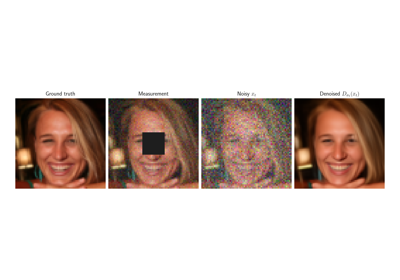
Noisy data-fidelity terms for diffusion posterior sampling