ILVRDataFidelity#
- class deepinv.sampling.ILVRDataFidelity(gamma=None, weight=1.0, rng=None, *args, **kwargs)[source]#
Bases:
ScoreSDEDataFidelityIterative Latent Variable Refinement (ILVR) data-fidelity term.
This corresponds to the \(p(y|x_t)\) approximation proposed in [26], and reviewed in [35]. ILVR is a preconditioned version of
deepinv.sampling.ScoreSDEDataFidelity: the mismatch against the noised measurements \(y_t = y + \sigma_t\epsilon\) is lifted back to the image space with the pseudo-inverse \(A^\dagger\) instead of the adjoint \(A^\top\),\[-\nabla_{x_t} \log p_t(y|x_t) \approx \lambda \frac{A^\dagger \left(A x_t - y_t\right)}{\sigma_y^2 + \gamma_t^2}, \qquad A^\dagger = \left(A^\top A\right)^{-1} A^\top,\]where \(\lambda\), exposed as
weight, controls the scale of the data-fidelity term.- Parameters:
gamma (Callable, float) – annealing parameter \(\gamma_t\). If
None(default), \(\gamma_t = \sigma_t\), the current diffusion noise level.weight (float) – Weighting factor \(\lambda\). Default:
1.0.rng (torch.Generator) – Random number generator used to noise the measurements, for reproducibility. Default:
None.
- grad(x, y, physics, sigma, *args, **kwargs)[source]#
Compute the ILVR data-fidelity gradient \(\lambda A^\dagger \left(A x_t - y_t\right) / (\sigma_y^2 + \gamma_t^2)\).
- Parameters:
x (torch.Tensor) – Current noisy iterate.
y (torch.Tensor) – Measurements.
physics (deepinv.physics.Physics) – physics model.
sigma (torch.Tensor, float) – Diffusion noise standard deviation.
- Returns:
ILVR gradient, with the same shape as
x.- Return type:
Examples using ILVRDataFidelity:#
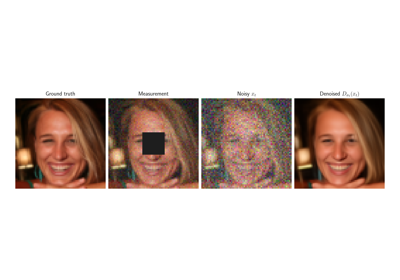
Noisy data-fidelity terms for diffusion posterior sampling