
GaussianNoise#
- class deepinv.physics.GaussianNoise(sigma=0.1, rng=None)[source]#
Bases:
NoiseModelGaussian noise \(y=z+\epsilon\) where \(\epsilon\sim \mathcal{N}(0,I\sigma^2)\).
- Parameters:
sigma (Union[float, torch.Tensor]) – Standard deviation of the noise.
rng (torch.Generator, None) – (optional) a pseudorandom random number generator for the parameter generation.
- Examples:
Adding gaussian noise to a physics operator by setting the
noise_modelattribute of the physics operator:>>> from deepinv.physics import Denoising, GaussianNoise >>> import torch >>> physics = Denoising() >>> physics.noise_model = GaussianNoise() >>> x = torch.rand(3, 1, 2, 2) >>> y = physics(x)
We can sum 2 GaussianNoise instances:
>>> gaussian_noise_1 = GaussianNoise(sigma=3.0)
>>> gaussian_noise_2 = GaussianNoise(sigma=4.0)
>>> gaussian_noise = gaussian_noise_1 + gaussian_noise_2
>>> y = gaussian_noise(x)
>>> gaussian_noise.sigma.item()
5.0
We can also multiply a GaussianNoise by a float:
\(scaled\_gaussian\_noise(x) = \lambda \times gaussian\_noise(x)\)>>> scaled_gaussian_noise = 3.0 * gaussian_noise >>> y = scaled_gaussian_noise(x) >>> scaled_gaussian_noise.sigma.item() 15.0
We can also create a batch of GaussianNoise with different standard deviations:
\(x=[x_1, ..., x_b]\)\(t=[[[[\lambda_1]]], ..., [[[\lambda_b]]]]\) a batch of scaling factors.\([t \times gaussian](x) = [\lambda_1 \times gaussian(x_1), ..., \lambda_b \times gaussian(x_b)]\)>>> t = torch.rand((x.size(0),) + (1,) * (x.dim() - 1)) # if x.shape = (b, 3, 32, 32) then t.shape = (b, 1, 1, 1) >>> batch_gaussian_noise = t * gaussian_noise >>> y = batch_gaussian_noise(x) >>> assert (t[0]*gaussian_noise).sigma.item() == batch_gaussian_noise.sigma[0].item(), "Wrong standard deviation value for the first GaussianNoise."
- Used in benchmarks:
- __add__(other)[source]#
Sum of 2 gaussian noises via + operator.
\(\sigma = \sqrt{\sigma_1^2 + \sigma_2^2}\)
- Parameters:
other (deepinv.physics.GaussianNoise) – Gaussian with standard deviation \(\sigma\)
- Returns:
(
deepinv.physics.GaussianNoise) – Gaussian noise with the sum of the linear operators.
- __mul__(other)[source]#
Element-wise multiplication of a GaussianNoise via
*operator.If
otheris aNoiseModel, then applies the multiplication fromNoiseModel.If
otheris afloat, then the standard deviation of the GaussianNoise is multiplied byother.\(x=[x_1, ..., x_b]\) a batch of images.\(\lambda\) a float.\(\sigma = [\lambda \times \sigma_1, ..., \lambda \times \sigma_b]\)If
otheris atorch.Tensor, then the standard deviation of the GaussianNoise is multiplied byother.\(x=[x_1, ..., x_b]\) a batch of images.\(other=[[[[\lambda_1]]], ..., [[[\lambda_b]]]]\) a batch of scaling factors.\(\sigma = [\lambda \times \sigma_1, ..., \lambda \times \sigma_b]\)
- Parameters:
other (float or torch.Tensor) – Scaling factor for the GaussianNoise’s standard deviation.
- Returns:
(
deepinv.physics.GaussianNoise) – A new GaussianNoise with the new standard deviation.
- forward(x, sigma=None, seed=None, **kwargs)[source]#
Adds the noise to measurements x
- Parameters:
x (torch.Tensor) – measurements
sigma (float, torch.Tensor) – standard deviation of the noise. If not
None, it will overwrite the current noise level.seed (int) – the seed for the random number generator, if
rngis provided.
- Returns:
noisy measurements
Examples using GaussianNoise:#


Reconstruct accelerated non-Cartesian breast MRI acquisition data

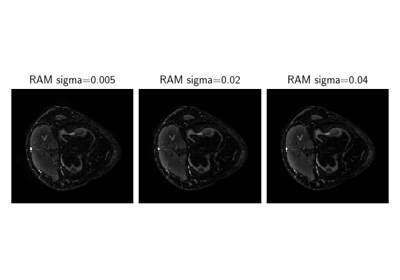
Reconstruct prospectively-undersampled raw multicoil MRI

3D denoising of brain MRI with wavelet and TV priors


Reconstructing an image using the deep image prior.

Expected Patch Log Likelihood (EPLL) for Denoising and Inpainting


Pattern Ordering in a Compressive Single Pixel Camera


PnP with custom optimization algorithm (Primal-Dual Condat-Vu)
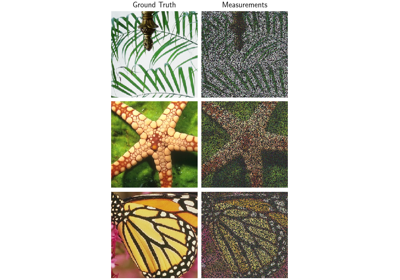

Regularization by Denoising (RED) for Super-Resolution.


Using state-of-the-art diffusion models from HuggingFace Diffusers with DeepInverse


Flow-Matching for posterior sampling and unconditional generation
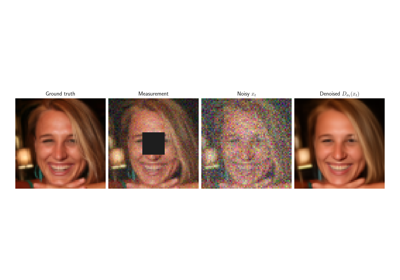
Noisy data-fidelity terms for diffusion posterior sampling


Self-supervised denoising with the Generalized R2R loss.


Self-supervised learning with measurement splitting


Deep Equilibrium (DEQ) algorithms for image deblurring


Reducing the memory and computational complexity of unfolded network training
