

DeteCTDataset#
- class deepinv.datasets.DeteCTDataset(root, problem='full', n_angles=3600, slice_ids='all', use_dict_output=False)[source]#
Bases:
ImageDataset2DeteCT dataset of 2D Computed Tomography acquisitions.
The dataset was acquired by Kiss et al.[1] and used for benchmarking CT reconstruction algorithms in Kiss et al.[2]. The data is industrial CT projection data (i.e. sinograms) of various materials acquired using a proprietary scanner from Centrum Wiskunde & Informatica. The samples contain materials resembling the attenuation of human anatomy; see Kiss et al.[1] for more details.
The projections (shape
(1,n_angles,956)) are preprocessed (flat/dark-corrected, log-transformed, all in PyTorch) following LION such that the setup matches exactly Kiss et al.[2], such that the dataset can be used to compare DeepInverse image reconstruction methods with the values reported in Kiss et al.[2].Each sample is scanned 3 times:
mode1,mode2andmode3. See below for their usage.“Ground truth”
xare also provided as iterative recons using all angles, of shape(1,1024,1024).To download the data from Zenodo, use
download_dataset, which extracts each archive into the2DeteCT_slicesXXXX-YYYY(+_RecSeg) subfolders in root. Note: for the test set, you only need to download slices4001-5000, i.e. dodinv.datasets.DeteCTDataset.download_dataset(root='/path/to/2DeteCT', blocks='test').- Parameters:
root (str, pathlib.Path) – root dir, should contain subfolders named
2DeteCT_slicesXXXX-YYYY(+_RecSeg)problem (str) – benchmarking problem from 2DeteCT. -
full:mode2acquired data (3600 projections) -sparse_view:mode2acquired data then evenly subsampled -limited_angle:mode2acquired data then limited angles taken -low_dose:mode1acquired data (3W instead of 90W) -beam_hardening:mode3acquired data (acquired without a filter, leading to beam-hardening)n_angles (int) – kept projections for sparse_view/limited_angle, defaults to 3600 (i.e. all angles).
slice_ids (str) –
all(default, every slice found from 1-5000),train/val/test(LION 3930/550/470 sample split), orood(out-of-distribution slices 5521-6370).use_dict_output (bool) – whether to return output as dict with keys “x”, “y”, “params” instead of tuple (default
False).
- Examples:
Download a single sample slice (ID 4531) from HuggingFace and load it:
>>> import shutil, deepinv as dinv
>>> from deepinv.datasets import DeteCTDataset, download_archive
>>> download_archive(dinv.utils.get_image_url("2DeteCT_slices_4001-5000_slice04531.zip"), "2DeteCT/data.zip", extract=True)
>>> x, y = DeteCTDataset("2DeteCT", slice_ids="test")[0]
>>> print(x.shape, y.shape) # (1,H,W), (1, num_angles, detector length)
torch.Size([1, 1024, 1024]) torch.Size([1, 3600, 956])
>>> shutil.rmtree("2DeteCT")
- References:
- static download_dataset(root, blocks='all', force_download=False)[source]#
Download and extract the 2DeteCT archives from Zenodo into
root.Each block’s raw data and reference reconstructions (RecSeg) are extracted into the
2DeteCT_slicesXXXX-YYYY(+_RecSeg) subfolders expected by the dataset.Warning
The archives are very large (up to ~34GB each);
blocks="all"needs several hundred GB of disk.- Parameters:
root (str, pathlib.Path) – dir to download into (same
rootpassed to init).blocks (str, list) – which slice ranges to download:
"all"(slices 1-5000),"test"(only slices 4001-5000, i.e. the benchmark test set),"ood"(out-of-distribution slices 5521-6370), or a list of ranges from["1-1000", "1001-2000", "2001-3000", "3001-4000", "4001-5000", "OOD"].force_download (bool) – re-download even if the archive already exists.
- static get_astra_geometry(problem='full', n_angles=None)[source]#
Get astra object geometry and project geometry for 2DeteCT setup.
Construct geometry objects to pass to
deepinv.physics.TomographyWithAstrain order to test physics-conditioned algorithms on the 2DeteCT benchmark.The object geometry values and fan-beam projection geometry values are taken from LION.
The projection geometry is defined as conebeam with one detector row.
Usage
import deepinv as dinv
obj_geom, proj_geom = dinv.datasets.DeteCTDataset.get_astra_geometry()
physics = dinv.physics.TomographyWithAstra(
    object_geometry=obj_geom,
    projection_geometry=proj_geom,
    is_2d=True, # important
    normalize=True,
    device=device,
    noise_model=dinv.physics.PoissonGaussianNoise(),
)
Examples using DeteCTDataset:#
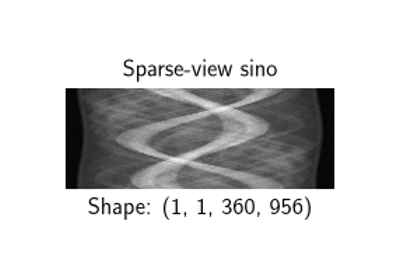
Reconstruct real CT sinograms with the 2DeteCT benchmark