

bmode#
- deepinv.utils.bmode(x, dim=-2, *, amplitude_floor_db=-60.0, dynamic_range=None, reference=None, normalize=True)[source]#
Compute log-compressed brightness mode (B-Mode) image.
\[\mathrm{B}(x) = 20 \log_{10} \left(\frac{x_a}{x_\mathrm{ref}} \right),\]where \(x_a\) is the envelope of \(x\), i.e. the modulus of its analytical signal (see
deepinv.utils.hilbert()) or its modulus if \(x\) is complex-valued, and \(x_\mathrm{ref}\) a reference amplitude. The result is clipped to \([\mathrm{amplitude\_floor\_db}, \mathrm{amplitude\_floor\_db} + \mathrm{dynamic\_range}]\).- Parameters:
x (torch.Tensor) – input signal of shape
(B, ...)dim (int) – dimension along which the envelope is computed. (default:
-2)amplitude_floor_db (float) – lower bound of the display window, in dB relative to the reference. (default:
-60)dynamic_range (float) – width of the display window in dB. If
None, the window ends at 0 dB. (default:None)reference (float, torch.Tensor) – reference amplitude mapped to 0 dB. If
None, the maximum of the envelope of each element of the batch. (default:None)normalize (bool) – if
True, the display window is linearly mapped to[0, 1], which is convenient for display or for saving the image. (default:True)
- Returns:
(
torch.Tensor) the log-compressed image, in dB or in[0, 1]ifnormalizeisTrue.- Return type:
Examples using bmode:#
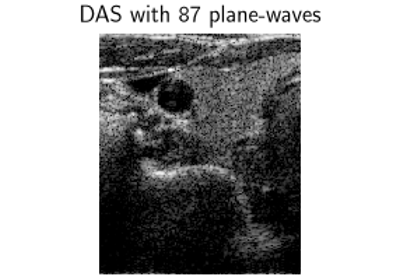
In-vivo ultrafast ultrasound reconstruction with Plug-and-Play