Examples#
All the examples have a download link at the end. You can load the example’s notebook on Google Colab and run them by adding the line
pip install git+https://github.com/deepinv/deepinv.git#egg=deepinv
to the top of the notebook (e.g., as in here).
Get started#
Get started with the 5 minute quickstart tutorial, or view it in Colab here.
Basics#


Models#


Reconstruct undersampled k-space for cardiac and brain MRI
Reconstruct prospectively-undersampled raw multicoil MRI
Physics#




Random phase retrieval and reconstruction methods.

Spectral Methods for Non-Circular Deblurring with Liu-Jia Padding





Poisson-Gaussian Denoising with the Generalized Anscombe Transform

Pattern Ordering in a Compressive Single Pixel Camera
Optimization#

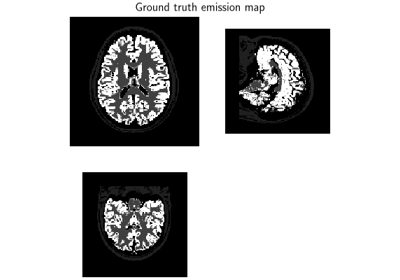
3D denoising of brain MRI with wavelet and TV priors

Expected Patch Log Likelihood (EPLL) for Denoising and Inpainting


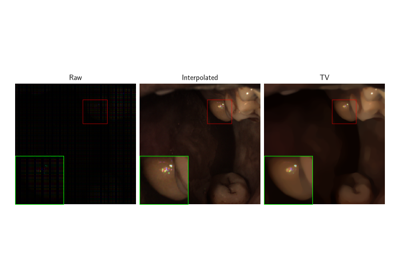

Patch priors for limited-angle computed tomography

Poisson Inverse Problems with Maximum-Likelihood Expectation-Maximization (MLEM)

Reconstructing an image using the deep image prior.
Plug-and-Play#

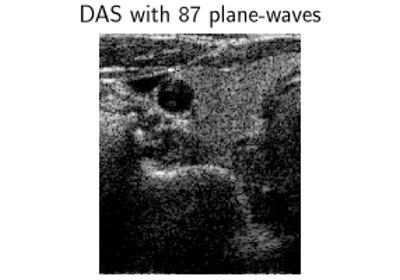
In-vivo ultrafast ultrasound reconstruction with Plug-and-Play
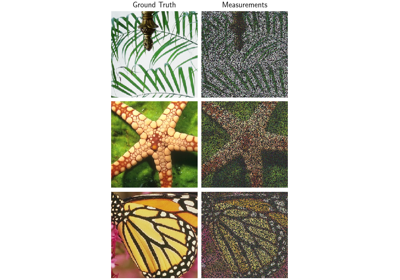

Plug-and-Play algorithm with Mirror Descent for Poisson noise inverse problems.

PnP with custom optimization algorithm (Primal-Dual Condat-Vu)

Regularization by Denoising (RED) for Super-Resolution.

Diffusion & MCMC#


Building your diffusion posterior sampling method using SDEs


Flow-Matching for posterior sampling and unconditional generation


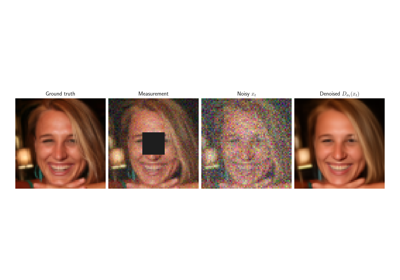
Noisy data-fidelity terms for diffusion posterior sampling


Using state-of-the-art diffusion models from HuggingFace Diffusers with DeepInverse
Unfolded#


Deep Equilibrium (DEQ) algorithms for image deblurring

Learned Iterative Soft-Thresholding Algorithm (LISTA) for compressed sensing


Reducing the memory and computational complexity of unfolded network training

Unfolded Chambolle-Pock for constrained image inpainting

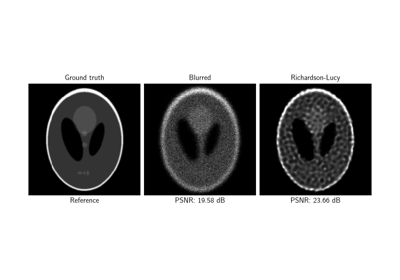
Blind Inverse Problems#


Self-Supervised Learning#


Self-supervised MRI reconstruction with Artifact2Artifact

Self-supervised denoising with the Generalized R2R loss.

Self-supervised denoising with the Neighbor2Neighbor loss.


Self-supervised learning from incomplete measurements of multiple operators.

Self-supervised learning with Equivariant Imaging for MRI.

Self-supervised learning with Equivariant Splitting

Self-supervised learning with measurement splitting
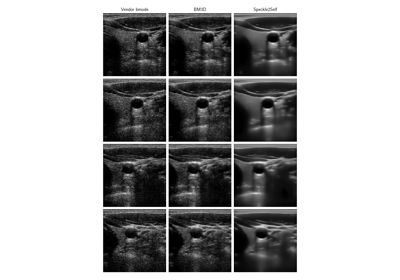
Transformations & Equivariance#

Adversarial Learning#

Imaging inverse problems with adversarial networks
External Libraries#


Low-dose CT with ASTRA backend and Total-Variation (TV) prior
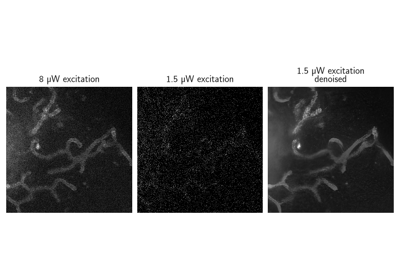
Low-intensity STED fluorescence microscopy denoising

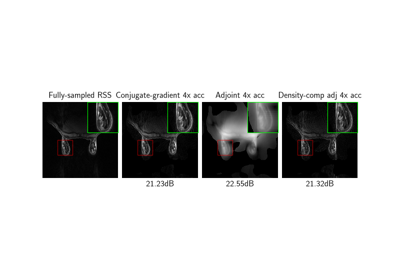
Reconstruct accelerated non-Cartesian breast MRI acquisition data
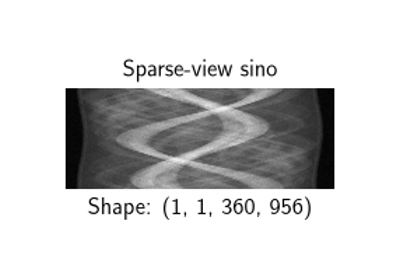
Reconstruct real CT sinograms with the 2DeteCT benchmark