

Note
New to DeepInverse? Get started with the basics with the 5 minute quickstart tutorial..
Blind inverse problems with no reference metrics#
In blind inverse problems, some parameters of the physics are unknown at test time. Running non-blind models requires knowing these parameters, which are often hard to estimate. For example, a denoiser needs the noise level \(\sigma\), a deblurring model needs the blur kernel.
No-reference (or blind) image quality metrics offer an approach for tuning these parameters without ground truth. They score a single image \(\hat{x}\) without ever seeing a reference, so they can be evaluated at test time on the reconstruction itself. If such a metric is a good proxy for reconstruction quality, we can sweep the unknown parameter, score each candidate reconstruction, and keep the best one, entirely without ground truth.
We take two problems where we do know the right physics parameter, hide it from the model, and check whether each no-reference metric recovers it:
Denoising. We corrupt an image with Gaussian noise of \(\sigma = 0.1\) and reconstruct it with
DRUNet[1], pretending the noise level is unknown and sweeping \(\sigma \in \{0.05, 0.1, 0.15, 0.2\}\).Deblurring. We blur an image with a Gaussian kernel of width \(\sigma = 2\) and reconstruct it with the
RAMfoundation model [2], pretending the kernel width is unknown and sweeping \(\sigma \in \{1, 2, 3, 4\}\).
We score every reconstruction with the five no-reference metrics of the library:
deepinv.loss.metric.BRISQUE[3], which scores how far the image departs from the natural scene statistics of high quality photographs, using a regressor trained on human quality ratings. Lower is better.deepinv.loss.metric.NIMA[4], which predicts the distribution of human opinion scores with a convolutional network. Higher is better. We use thetechnicalhead, which is trained to rate distortion rather than aesthetic appeal.deepinv.loss.metric.NIQE[5], which measures the distance between the local statistics of the image and a model fitted on high quality images. Lower is better.deepinv.loss.metric.SharpnessIndex[6][7], which measures sharpness through the global phase coherence of the image. Higher is better.deepinv.loss.metric.BlurStrength[8], which estimates blur from how much the image changes when it is deliberately blurred further. Lower is better.
Setup#
We use natural images which is what the above no-reference metrics were designed for.
Every metric is also constructed with center_crop=-16 to disregard edge effects.
import torch
import matplotlib.pyplot as plt

import deepinv as dinv
from deepinv.utils import plot

device = dinv.utils.get_device()
torch.manual_seed(0)

x = dinv.utils.load_example(
    "div2k_valid_hr_0877.png", img_size=256, resize_mode="crop"
).to(device)

crop = -16

metrics = [
    dinv.loss.metric.BRISQUE(device=device, center_crop=crop),
    dinv.loss.metric.NIMA(variant="technical", device=device, center_crop=crop),
    dinv.loss.metric.NIQE(denominator=1 / 255, device=device, center_crop=crop),
    dinv.loss.metric.SharpnessIndex(center_crop=crop),
    dinv.loss.metric.BlurStrength(center_crop=crop),
]
Selected GPU 0 with 7510.4375 MiB free memory
Experiment 1: denoising with an unknown noise level#
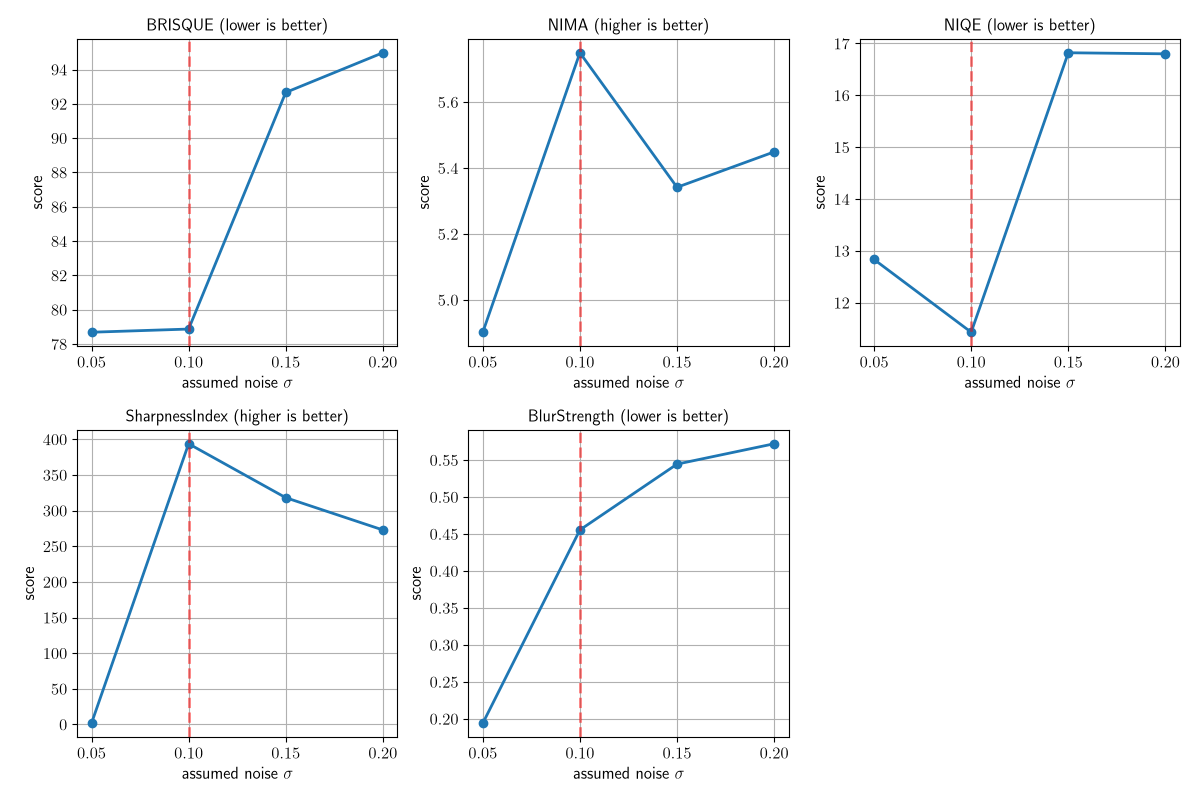
We add Gaussian noise of \(\sigma = 0.1\) and run DRUNet at four candidate noise levels. Under-estimating \(\sigma\) leaves visible noise in the output, over-estimating it removes the noise but also the fine texture of the image.
sigma_true = 0.1
physics = dinv.physics.Denoising(dinv.physics.GaussianNoise(sigma=sigma_true))

torch.manual_seed(0)  # fix the noise realization so the sweep is reproducible
y = physics(x)

denoiser = dinv.models.DRUNet(pretrained="download", device=device)
sigmas = [0.05, 0.1, 0.15, 0.2]

denoised = []
for s in sigmas:
    with torch.no_grad():
        denoised.append(denoiser(y, s))

plot(
    [x, y] + denoised,
    titles=["ground truth", rf"noisy ($\sigma={sigma_true}$)"]
    + [rf"DRUNet $\sigma={s}$" for s in sigmas],
    rescale_mode="clip",
)

Plot the no-reference metrics as a function of the assumed noise level
plt.figure(figsize=(12, 8))

with torch.no_grad():
    for i, metric in enumerate(metrics):
        scores = []
        for x_hat in denoised:
            scores.append(metric(x_hat).item())

        name = metric.__class__.__name__
        plt.subplot(2, 3, i + 1)
        plt.plot(sigmas, scores, marker="o", label=name)
        plt.title(
            f"{name} ({'lower is better' if metric.lower_better else 'higher is better'})"
        )
        plt.xlabel(rf"assumed noise $\sigma$")
        plt.axvline(x=sigma_true, color="red", linestyle="--", alpha=0.5)
        plt.ylabel(f"score")
        plt.grid()

plt.tight_layout()
plt.show()
Experiment 2: deblurring with an unknown kernel width#
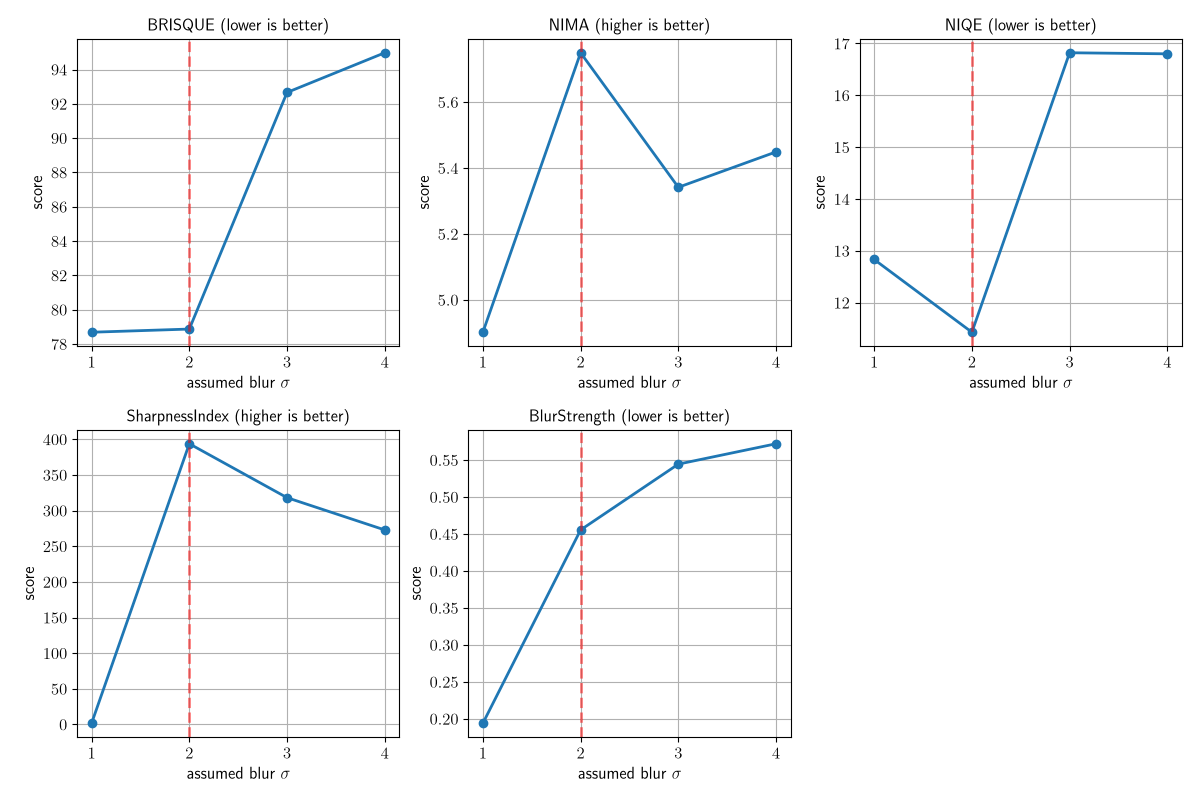
We blur the image with a Gaussian kernel of width \(\sigma = 2\) (plus a little noise) and reconstruct with RAM with the 4 candidate kernels. Assuming too small a kernel leaves the image blurry, assuming too large a kernel makes the model over-sharpen and introduces ringing and other artifacts.
blur_true = 2.0

blur_physics = dinv.physics.BlurFFT(
    img_size=x.shape[1:],
    filter=dinv.physics.functional.gaussian_blur(sigma=(blur_true, blur_true)),
    device=device,
    noise_model=dinv.physics.GaussianNoise(sigma=0.01),
)

# fix the noise realization so the sweep is reproducible
torch.manual_seed(0)
y = blur_physics(x)

model = dinv.models.RAM(device=device)
blur_sigmas = [1.0, 2.0, 3.0, 4.0]

with torch.no_grad():
    deblurred = []
    for s in blur_sigmas:
        # update physics to use the candidate kernel width, and run RAM
        blur_physics.update(filter=dinv.physics.functional.gaussian_blur(sigma=(s, s)))
        deblurred.append(model(y, blur_physics))

plot(
    [x, y] + deblurred,
    titles=["ground truth", rf"blurred ($\sigma={blur_true}$)"]
    + [rf"RAM $\sigma={s}$" for s in blur_sigmas],
    rescale_mode="clip",
)

/local/jtachell/deepinv/deepinv/deepinv/physics/forward.py:245: UserWarning: The provided ``filter`` is on a different device than the current filter ``self.filter``. The current underlying self.filter.device={self.filter.device} will be used.
  self.update_parameters(**kwargs)
Plot the no-reference metrics as a function of the assumed blur
plt.figure(figsize=(12, 8))

with torch.no_grad():
    for i, metric in enumerate(metrics):
        scores = []
        for x_hat in denoised:
            scores.append(metric(x_hat).item())

        name = metric.__class__.__name__
        plt.subplot(2, 3, i + 1)
        plt.plot(blur_sigmas, scores, marker="o", label=name)
        plt.title(
            f"{name} ({'lower is better' if metric.lower_better else 'higher is better'})"
        )
        plt.xlabel(rf"assumed blur $\sigma$")
        plt.axvline(x=blur_true, color="red", linestyle="--", alpha=0.5)
        plt.ylabel(f"score")
        plt.grid()

plt.tight_layout()
plt.show()
- References:
Total running time of the script: (0 minutes 7.412 seconds)
