
DecomposablePhysics#
- class deepinv.physics.DecomposablePhysics(U=None, V_adjoint=None, img_size=None, U_adjoint=None, V=None, mask=1.0, device='cpu', **kwargs)[source]#
Bases:
LinearPhysicsParent class for linear operators with SVD decomposition.
The singular value decomposition is expressed as
\[A = U\text{diag}(s)V^{\top} \in \mathbb{R}^{m\times n}\]where \(U\in\mathbb{C}^{m\times m}\) and \(V\in\mathbb{C}^{n\times n}\) are orthonormal linear transformations and \(\text{diag}(s)\in\mathbb{R}_{+}^{m \times n}\) is the possibly rectangular singular values matrix.
- Parameters:
U (None | Callable) – orthonormal transformation. If
None(default), it is set to the identity function.V_adjoint (None | Callable) – transpose of V. If
None(default), it is set to the identity function.img_size (tuple) – (optional, only required if V and/or U_adjoint are not provided) size of the signal/image
x, e.g.(C, ...)whereCis the number of channels and...are the spatial dimensions, used for the automatic adjoint computation.U_adjoint (None | Callable) – transpose of U. If
None(default), it is computed automatically usingdeepinv.physics.adjoint_function()from theUfunction and theimg_sizeparameter. This automatic adjoint is computed using automatic differentiation, which is slower than a closed form adjoint, and can have a larger memory footprint. If you want to use the automatic adjoint, you should set theimg_sizeparameter.V (None | Callable) – If
None(default), it is computed automatically usingdeepinv.physics.adjoint_function()from theV_adjointfunction and theimg_sizeparameter. This automatic adjoint is computed using automatic differentiation, which is slower than a closed form adjoint, and can have a larger memory footprint. If you want to use the automatic adjoint, you should set theimg_sizeparameter.mask (torch.nn.parameter.Parameter, float) – Singular values of the transform
device (torch.device, str) – cpu or cuda, every registered buffer and module parameters are recursively pushed onto the device during initialization.
- Examples:
Recreation of the Inpainting operator using the DecomposablePhysics class:
>>> from deepinv.physics import DecomposablePhysics
>>> seed = torch.manual_seed(0)  # Random seed for reproducibility
>>> img_size = (1, 1, 3, 3)  # Input size
>>> mask = torch.tensor([[1, 0, 1], [1, 0, 1], [1, 0, 1]])  # Binary mask
>>> U = lambda x: x  # U is the identity operation
>>> U_adjoint = lambda x: x  # U_adjoint is the identity operation
>>> V = lambda x: x  # V is the identity operation
>>> V_adjoint = lambda x: x  # V_adjoint is the identity operation
>>> mask_svd = mask.float().unsqueeze(0).unsqueeze(0)  # Convert the mask to torch.Tensor and adjust its dimensions
>>> physics = DecomposablePhysics(U=U, U_adjoint=U_adjoint, V=V, V_adjoint=V_adjoint, mask=mask_svd)
Apply the operator to a random tensor:
>>> x = torch.randn(img_size)
>>> with torch.no_grad():
...     physics.A(x)  # Apply the masking
tensor([[[[ 1.5410, -0.0000, -2.1788],
          [ 0.5684, -0.0000, -1.3986],
          [ 0.4033,  0.0000, -0.7193]]]])
- A(x, mask=None, **kwargs)[source]#
Applies the forward operator \(y = A(x)\).
If a mask/singular values is provided, it is used to apply the forward operator, and also stored as the current mask/singular values.
- Parameters:
x (torch.Tensor) – input tensor
mask (torch.nn.parameter.Parameter, float) – singular values.
- Returns:
output tensor
- Return type:
- A_A_adjoint(y, mask=None, **kwargs)[source]#
A helper function that computes \(A A^{\top}y\).
Using the SVD decomposition, we have \(A A^{\top} = U\text{diag}(s^2)U^{\top}\).
- Parameters:
y (torch.Tensor) – measurement.
- Returns:
(
torch.Tensor) the product \(AA^{\top}y\).
- A_adjoint(y, mask=None, **kwargs)[source]#
Computes the adjoint of the forward operator \(\tilde{x} = A^{\top}y\).
If a mask/singular values is provided, it is used to apply the adjoint operator, and also stored as the current mask/singular values.
- Parameters:
y (torch.Tensor) – input tensor
mask (torch.nn.parameter.Parameter, float) – singular values.
- Returns:
output tensor
- Return type:
- A_adjoint_A(x, mask=None, **kwargs)[source]#
A helper function that computes \(A^{\top} A x\).
Using the SVD decomposition, we have \(A^{\top}A = V\text{diag}(s^2)V^{\top}\).
- Parameters:
x (torch.Tensor) – signal/image.
- Returns:
(
torch.Tensor) the product \(A^{\top}Ax\).
- A_dagger(y, mask=None, **kwargs)[source]#
Computes \(A^{\dagger}y = x\) in an efficient manner leveraging the singular vector decomposition.
- Parameters:
y (torch.Tensor) – a measurement \(y\) to reconstruct via the pseudoinverse.
- Returns:
(
torch.Tensor) The reconstructed image \(x\).
- U(x)[source]#
Applies the \(U\) operator of the SVD decomposition.
Note
This method should be overwritten by the user to define its custom
DecomposablePhysicsoperator.- Parameters:
x (torch.Tensor) – input tensor
- U_adjoint(x, **kwargs)[source]#
Applies the \(U^{\top}\) operator of the SVD decomposition.
Note
This method should be overwritten by the user to define its custom
DecomposablePhysicsoperator.- Parameters:
x (torch.Tensor) – input tensor
- V(x, **kwargs)[source]#
Applies the \(V\) operator of the SVD decomposition.
Note
This method should be overwritten by the user to define its custom
DecomposablePhysicsoperator.- Parameters:
x (torch.Tensor) – input tensor
- V_adjoint(x)[source]#
Applies the \(V^{\top}\) operator of the SVD decomposition.
Note
This method should be overwritten by the user to define its custom
DecomposablePhysicsoperator.- Parameters:
x (torch.Tensor) – input tensor
- prox_l2(z, y, gamma, **kwargs)[source]#
Computes proximal operator of \(f(x)=\frac{\gamma}{2}\|Ax-y\|^2\) in an efficient manner leveraging the singular vector decomposition.
- Parameters:
z (torch.Tensor, float) – signal tensor
y (torch.Tensor) – measurements tensor
gamma (float) – hyperparameter \(\gamma\) of the proximal operator
- Returns:
(
torch.Tensor) estimated signal tensor
Examples using DecomposablePhysics:#



Reconstruct undersampled k-space for cardiac and brain MRI


3D denoising of brain MRI with wavelet and TV priors


Reconstructing an image using the deep image prior.

Expected Patch Log Likelihood (EPLL) for Denoising and Inpainting

Patch priors for limited-angle computed tomography

Poisson Inverse Problems with Maximum-Likelihood Expectation-Maximization (MLEM)


Poisson-Gaussian Denoising with the Generalized Anscombe Transform
Spectral Methods for Non-Circular Deblurring with Liu-Jia Padding


Pattern Ordering in a Compressive Single Pixel Camera


PnP with custom optimization algorithm (Primal-Dual Condat-Vu)

Plug-and-Play algorithm with Mirror Descent for Poisson noise inverse problems.


Using state-of-the-art diffusion models from HuggingFace Diffusers with DeepInverse

Building your diffusion posterior sampling method using SDEs


Flow-Matching for posterior sampling and unconditional generation
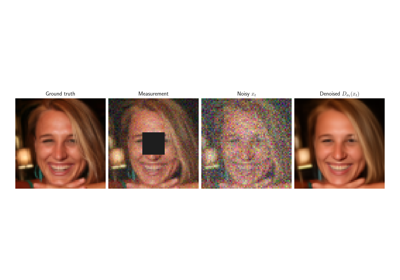
Noisy data-fidelity terms for diffusion posterior sampling


Self-supervised MRI reconstruction with Artifact2Artifact


Self-supervised learning with Equivariant Imaging for MRI.

Self-supervised learning with Equivariant Splitting


Self-supervised learning from incomplete measurements of multiple operators.

Self-supervised denoising with the Neighbor2Neighbor loss.


Self-supervised denoising with the Generalized R2R loss.


Deep Equilibrium (DEQ) algorithms for image deblurring


Reducing the memory and computational complexity of unfolded network training

Unfolded Chambolle-Pock for constrained image inpainting