DDRMDataFidelity#
- class deepinv.sampling.DDRMDataFidelity(denoiser=None, weight=1.0, eta=0.85, clip=None, sigma=0.01, eps=1e-6)[source]#
Bases:
NoisyDataFidelityDenoising Diffusion Restoration Models (DDRM) data-fidelity term.
It can be used to build custom DDRM-based diffusion samplers with
deepinv.sampling.PosteriorDiffusion. A self-contained implementation of DDRM is available indeepinv.sampling.DDRM.This adapts the spectral measurement update of Kawar et al.[1] for a decomposable linear operator \(A = U \Sigma V^\top\) (
deepinv.physics.DecomposablePhysics) and Gaussian measurement noise with standard deviation \(\sigma_y\), in the VE parametrization \(x_t = x_0 + \sigma_t \omega\).In the SVD domain, let \(\bar{x}_i = (V^\top x_t)_i\), \(\bar{y}_i = (U^\top y)_i / s_i\) and \(\nu_i = \sigma_y / s_i\) for each singular value \(s_i\). Components with \(s_i < \sigma_y\) are treated as unmeasured and left unchanged.
It provides an approximation of the gradient of the log-likelihood \(\log p_t(y \vert x_t)\) in the SVD domain as:
\[-\nabla_{x_t} \log p_t(y \vert x_t) \approx \lambda V \Sigma^\top W \left(\sigma_y^2 \mathrm{Id} + \sigma_t^2 \Sigma \Sigma^\top\right)^{-1} \left(\Sigma V^\top \denoiser{\tilde{x}_t}{\sigma_t} - U^\top y\right),\]where \(W\) is diagonal with \(W_i = 1\) if \(\sigma_t \geq \nu_i\) and \(W_i = \left(\sigma_t / (2 \nu_i)\right)^2\) otherwise; and \(\tilde{x}_t = V \left(\bar{x} + \lambda \kappa \odot (\bar{y} - \bar{x})\right)\), with
\[\begin{split}\kappa_i = \begin{cases} 1 - \frac{1}{\sqrt{2}} \sqrt{1 - \nu_i^2 / \sigma_t^2} & \text{if } \sigma_t \geq \nu_i, \\ \min\left(\sqrt{1 - \eta^2} \, \sigma_t / \nu_i, 1\right) & \text{if } \sigma_t < \nu_i. \end{cases}\end{split}\]Here \(\eta\) is the stochasticity parameter of DDRM, and \(\lambda\), exposed as
weight(corresponding to \(\eta_b\) in Kawar et al.[1]), controls the strength of both steps. The measurement noise level \(\sigma_y\) is read fromphysics.noise_model.sigmawhen available, and defaults tosigmaotherwise.The approximation \(-\nabla_{x_t} \log p_t(y \vert x_t)\) also carries measurement noise through \(U^\top y\); as \(y\) is fixed, the same noise realization enters the estimate on every step. The parameters \(\eta\) controls the amount of additional noise added at each step.
- Parameters:
denoiser (deepinv.models.Denoiser) – Denoiser network. It may be left as
Noneweight (float) – Weighting factor \(\lambda\) (called \(\eta_b\) in Kawar et al.[1]). Default:
1.0.eta (float) – Stochasticity parameter \(\eta \in [0, 1]\) of DDRM. Default:
0.85.clip (tuple[float]) – If not
None, clip the denoised output into[clip[0], clip[1]]interval. Default:None.sigma (float) – Fallback measurement noise standard deviation \(\sigma_y\) used when
physics.noise_modeldoes not definesigma. Default:0.01.eps (float) – Numerical floor added to the spectral denominator. Default:
1e-6.
- References:
- grad(x, y, physics, sigma, *args, get_model_outputs=False, **kwargs)[source]#
Compute the DDRM noisy data-fidelity gradient approximation.
\[-\nabla_{x_t} \log p_t(y \vert x_t) \approx \lambda V \Sigma^\top W \left(\sigma_y^2 \mathrm{Id} + \sigma_t^2 \Sigma \Sigma^\top\right)^{-1} \left(\Sigma V^\top \denoiser{\tilde{x}_t}{\sigma_t} - U^\top y\right)\]- Parameters:
x (torch.Tensor) – Current noisy iterate.
y (torch.Tensor) – Measurements.
physics (deepinv.physics.DecomposablePhysics) – Decomposable physics operator.
sigma (torch.Tensor, float) – Diffusion noise standard deviation.
get_model_outputs (bool) – If
True, also return the denoised output \(\denoiser{\tilde{x}_t}{\sigma_t}\) along with the score. Default:False.
- Returns:
DDRM gradient, with the same shape and dtype as
x(and denoised output ifget_model_outputsisTrue).- Return type:
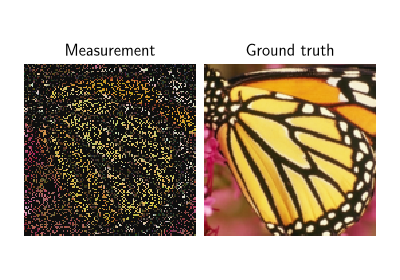
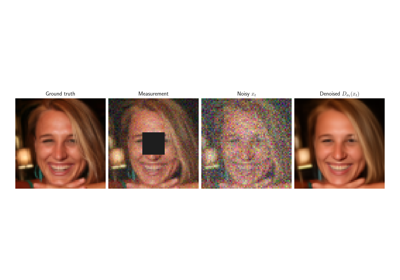
Examples using DDRMDataFidelity:#
Noisy data-fidelity terms for diffusion posterior sampling